We Tested 8 Cantilevered Bassinets for Tilting. Here’s Why Our Experts Don’t Recommend Them.
Our evaluations raised questions about whether the one-sided design was the safest choice for newborns


More than a million baby bassinets are sold in the U.S. each year to new and expecting parents. They’re popular for both practical and safety reasons. A bassinet can make those first few months with a newborn a little easier. Keep your baby close to your bed and you won’t have to stumble across the room every time there’s a feeding, diaper change, or 3 a.m. pacifier hunt. And the American Academy of Pediatrics recommends room-sharing—keeping your baby in the same room but not the same bed—for at least the first six months to reduce the risk of sudden unexpected infant death (SUID), which for many families means parking a bassinet bedside for at least a few months.
But when it comes to safe newborn sleeping, the right bassinet matters. According to Joan Muratore, who leads Consumer Reports’ bassinet testing program, if the sleep surface tilts, a baby can slip down or roll over and potentially end up face down or with their face pressed against the bassinet’s side wall, which might be up against a mattress or bedding. “Tilting of the sleep surface is a concern because the babies who will sleep in bassinets are newborn to just a few months old, and cannot sit up or reliably move their heads from side to side,” Muratore says. If a baby rolls into an unsafe position in the bassinet, “they are too young to be able to reorient themselves and may suffocate.”
That concern is at the heart of CR’s recent testing of a type of bassinet called a cantilevered bassinet, in which the sleeping surface is supported by a frame on only one side. The design allows the bassinet to extend over an adult bed, making it easier for parents to reach their baby.
The trade-off? When weight is placed inside, the sleep surface can move—and CR’s safety experts want parents to understand the risks of that design.
- Why Cantilevered Bassinets Have Raised Red Flags Before
- How We Tested Cantilevered Bassinets and What We Found
- Why a Few Degrees Matter for Safety
- So If a Cantilevered Bassinet Meets a Standard, Is It Safe?
- Companies Respond
- What to Do If You Already Have a Cantilevered Bassinet
- What to Look for When Choosing a Bassinet
Why Cantilevered Bassinets Have Raised Red Flags Before
This isn’t the first time CR has investigated cantilevered bassinets due to safety concerns.
In 2024, CR published its evaluations of two specific models of cantilevered bassinets—the Ingenuity Dream & Grow Bedside Bassinet and the Halo BassiNest Flex Portable Bassinet. That was after finding numerous online complaints and reports to the Consumer Product Safety Commission, the federal agency with oversight of children’s products, including bassinets, describing babies rolling toward a side of the bassinet or onto their stomachs. According to incident reports from the agency’s public database at SaferProducts.gov, at least two deaths have occurred in an Ingenuity Dream & Grow Bedside Bassinet: a 4-month-old boy in August 2019 and a 1-month-old girl in January 2022. In both cases, the babies were put to sleep on their backs but were later found on their stomachs. CR’s own testing confirmed that both bassinets could tilt when weight was applied.

Photo: Scott Meadows/Consumer Reports Photo: Scott Meadows/Consumer Reports
Beginning in 2024, CR called for the Halo BassiNest Flex to be recalled after additional complaints surfaced. A spokesperson for Halo confirmed that the product was discontinued in November 2024 and that the “decision to discontinue was unrelated to the safety of the product.” The Halo BassiNest Flex was never recalled.
Concerns about cantilevered bassinets predated CR’s investigations into those two specific models. In 2021, the CPSC wrote to ASTM International, an organization that develops product safety standards with input from product experts, safety advocates, and other stakeholders (CR is an active member). In the letter, the agency highlighted potential risks associated with cantilevered bassinets and called for the bassinet standard to address them. The standard was ultimately updated to include requirements specifically addressing the stability of cantilevered designs, and those updates took effect on Feb. 21, 2026.
But by this time, dozens of parents using cantilevered bassinets had reported tilting issues in everyday use. One reviewer on SaferProducts.gov said their newborn “kept sliding to one side” when the bassinet was swiveled over the bed. Another said their baby repeatedly ended up against the side wall. Both said they used a level to confirm that the sleeping surface was tilted.
How We Tested Cantilevered Bassinets and What We Found
CR tested eight cantilevered bassinets representing a range of brands and prices to see whether the sleeping surface tilted when weight was applied. The goal was straightforward: When a baby is lying in the bassinet, does the sleeping surface stay level? That question matters because a bassinet can look perfectly flat when it’s empty, but shift when weight is added.
“Meeting the current safety standard is important, but it doesn’t necessarily answer every question about how a product performs during everyday use,” Kapoor says. The team reviewed incident data and reports submitted to the CPSC, along with information from ASTM discussions and CPSC staff members about cantilevered bassinets. Those sources raised questions about whether cantilevered bassinets might work differently from traditional four-legged designs. CR then conducted its own testing “to better understand how these products perform, particularly with respect to how the sleep surface angle changes under a load.”
To simulate the weight of a baby, testers applied a standardized load and measured the incline of the sleep surface on both sides. They also added weight to the center and tested the head-to-toe angle. The current federal standard sets a maximum head-to-toe inclination of 10 degrees and a maximum side-to-side, or lateral, inclination of 7 degrees, so CR used those as its benchmarks. But it’s important to note that Consumer Reports doesn’t conduct compliance testing, and our results aren’t meant to be seen as such. Manufacturers, accredited testing labs, and the CPSC evaluate products for compliance, and no legal judgments can be made from CR’s findings. The results of our testing are meant to provide guidance about which products may have comparatively higher tilt angles, not to identify the point at which the tilting of the sleep surface will have measurable harmful health effects, or to assess compliance with a federal safety standard.


1 / 3 : In CR’s evaluations of cantilevered bassinets, a standardized weight (known as an infant hinged weight gauge) was added to the sleep surface.
Photo: Scott Meadows/Consumer Reports
None of the models we tested exceeded a head-to-toe tilt of 3.6 degrees, which is below our experts’ level of concern. The bassinet with the highest lateral tilt angle in CR’s tests was the Ingenuity Dream & Grow Bedside Baby Bassinet. It had a lateral tilt of 7.11 degrees in the initial test. CR retested the bassinet using a new sample, and the tilt measured 7.75 degrees.
CR found another pattern in the test results that caught its attention. In seven of the eight bassinets, the freestanding side tilted more than the other side when weight was applied—in some cases by more than 4 degrees. In other words, the side without the same structural support tended to move more. The Ingenuity Dream & Grow was the one exception, in which a higher tilt angle was observed on the side closer to the support arm.
Our results don’t mean every cantilevered bassinet CR tested will perform the same way, but they do show that these one-sided designs don’t perform the same way when weight is added.
CR believes the lateral inclination limit should be much stricter. “It’s why we’ve advocated through the years for a maximum side tilt of 0 degrees, with a tolerance of no more than 1 degree, essentially requiring the sleeping surface to remain flat,” says Oriene Shin, manager of safety advocacy at CR. CR’s position is based in part on its analysis of SaferProducts.gov reports and publicly available reviews, which found numerous complaints involving cantilevered bassinets and concerns that their sleeping surfaces weren’t staying level.
Results: Cantilevered Bassinet Testing
Listed alphabetically. Level of concern is based on independent testing of lateral inclination angles, as well as user reviews and safety incident reports. Number and severity of incidents generally correspond with the tilt angle we observed.
Average inclination (degrees)
- 0-0.99°
- 1-2.99°
- 3-6.99°
- 7° and above
| Average Inclination (Degrees) | |||
|---|---|---|---|
| Level of Concern | Freestanding Side | Opposite Side | |
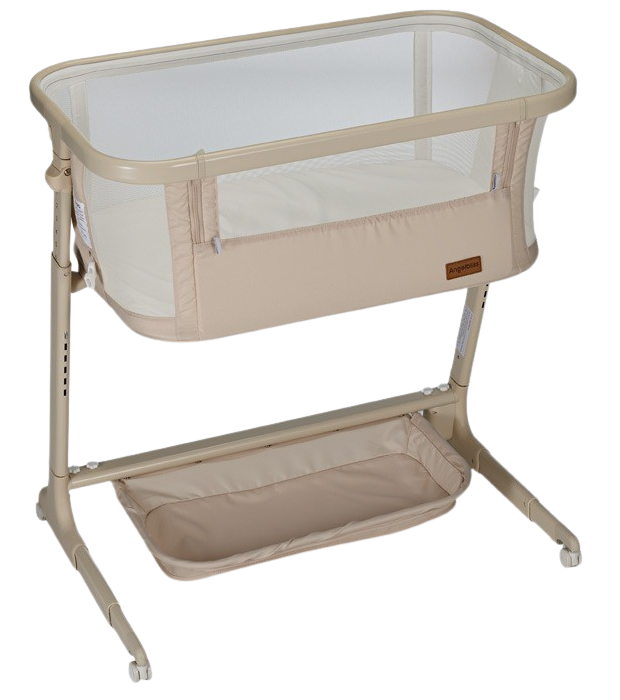
Angelbliss
3 in 1 Smart Electric Baby Bassinet
|
Level of concern 2 out of 5
|
Freestanding side 4.63° — orange, high concern | Opposite side 0.25° — green, low concern |
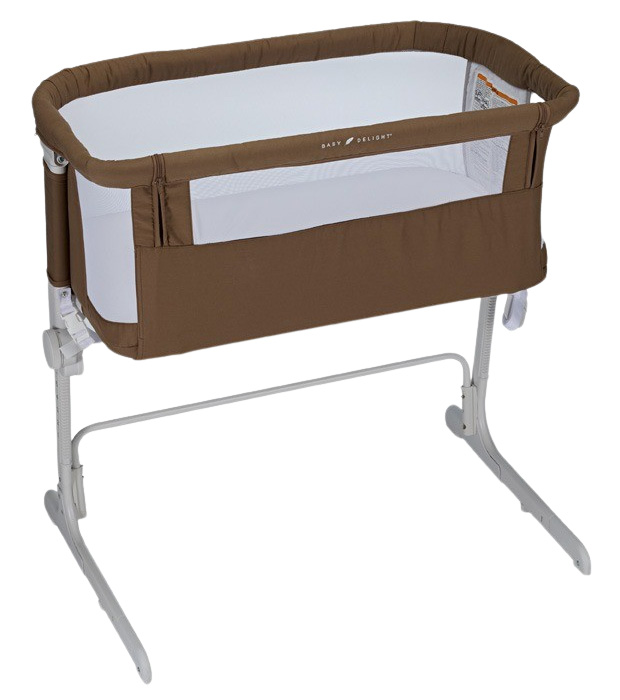
Baby Delight
Beside Me Dreamer Organic Bassinet & Bedside Sleeper
|
Level of concern 2 out of 5
|
Freestanding side 4.58° — orange, high concern | Opposite side 0.08° — green, low concern |
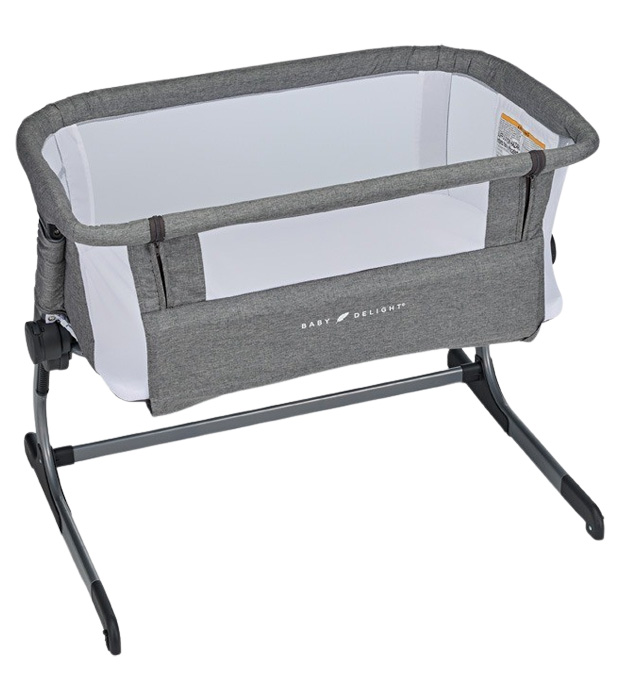
Baby Delight
Beside Me Dreamer Bassinet & Bedside Sleeper
|
Level of concern 2 out of 5
|
Freestanding side 3.15° — orange, high concern | Opposite side 0.6° — green, low concern |
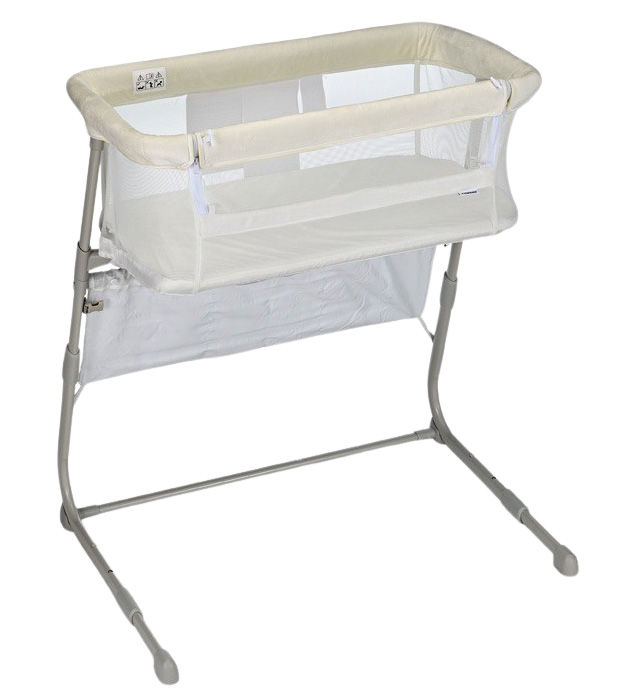
Cowiewie
Bassinet Bedside Sleeper
|
Level of concern 3 out of 5
|
Freestanding side 2.2° — yellow, moderate concern | Opposite side 0.25° — green, low concern |
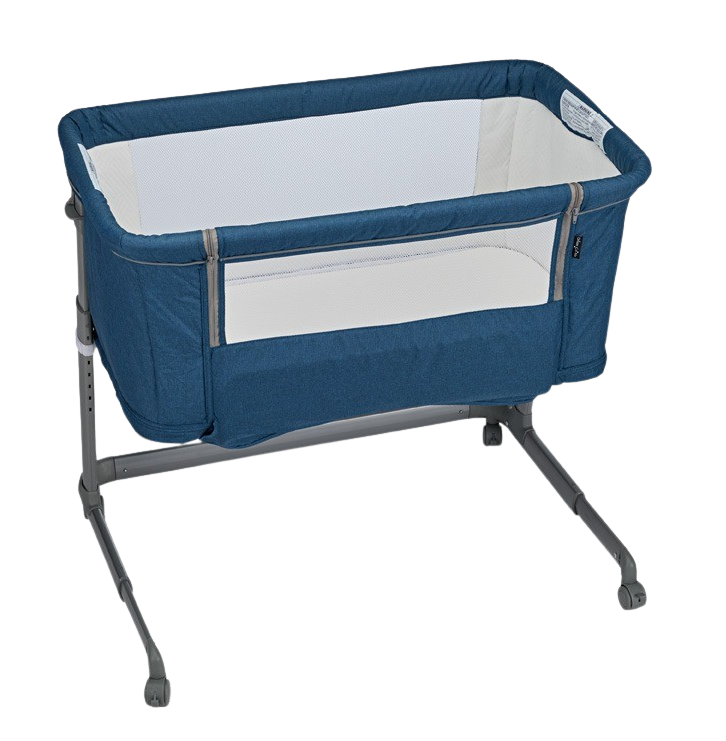
Dream On Me
Skylar Bassinet and Bedside Sleeper
|
Level of concern 3 out of 5
|
Freestanding side 1.35° — yellow, moderate concern | Opposite side 0.1° — green, low concern |
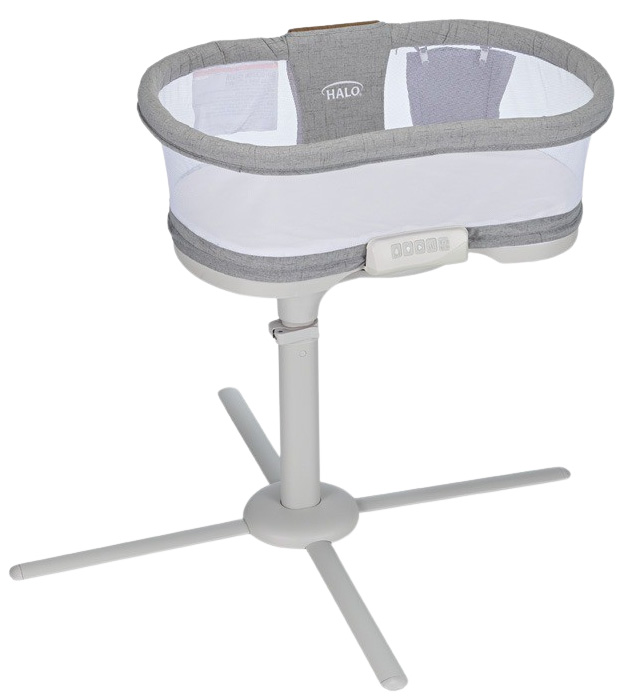
Halo
BassiNest Swivel Sleeper Luxe
|
Level of concern 3 out of 5
|
Freestanding side 1.02° — yellow, moderate concern | Opposite side 0.25° — green, low concern |
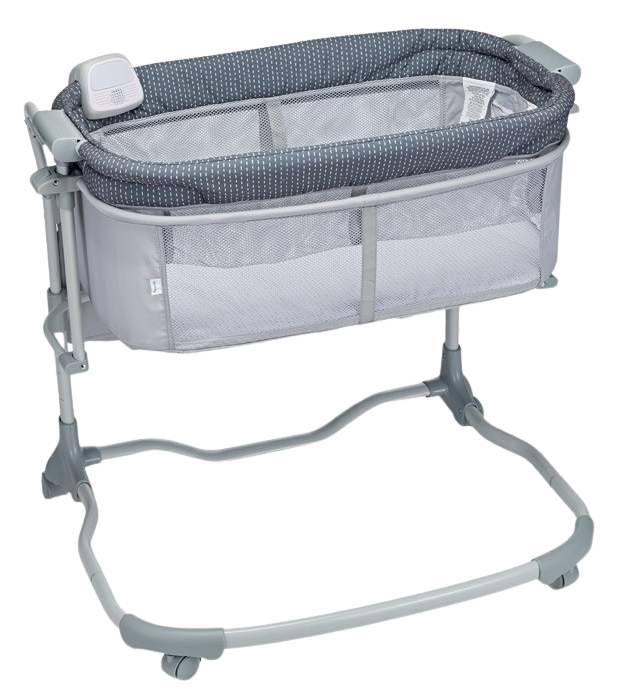
Ingenuity
Dream & Grow Bedside Baby Bassinet
|
Level of concern 1 out of 5
|
Freestanding side 3.52° — orange, high concern | Opposite side 7.11° — red, most serious concern |
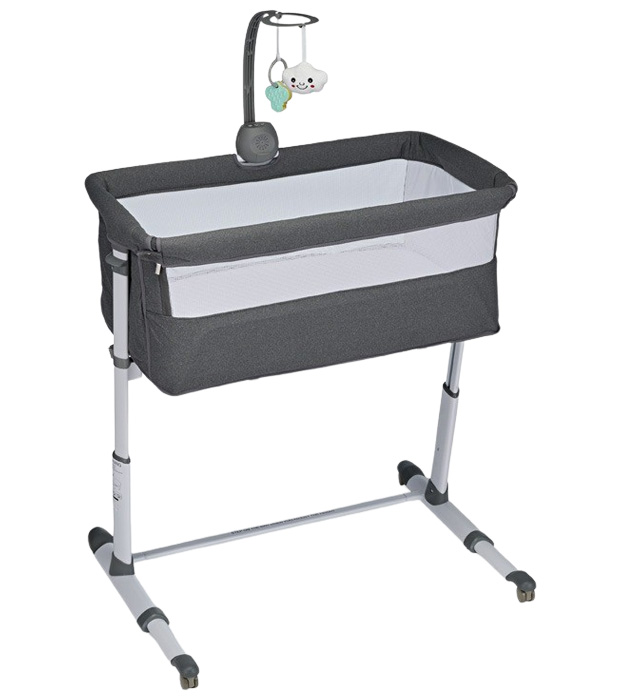
Ronbei
Baby Bassinet Bedside Sleeper
|
Level of concern 2 out of 5
|
Freestanding side 3.92° — orange, high concern | Opposite side 1.25° — yellow, moderate concern |
Each figure is the average of repeated measurements taken across the sleep surface. Source: Consumer Reports testing.
CR isn’t the only organization conducting independent lab testing to evaluate the stability of cantilevered bassinets. A research group at the Georgia Institute of Technology, led by William Singhose, a professor of mechanical engineering, analyzed over 100 customer reviews, and then conducted its own testing of a particular model, the Halo BassiNest. The reviews helped researchers identify potential problems, but engineering testing revealed something the reviews alone couldn’t: The structure supporting the sleeping surface could continue to deflect over time. The testing results, published in two papers in 2023 and 2024, described potentially dangerous tilting of the Halo BassiNest and degradation over time. These tests raise important questions about what happens when such a cantilevered bassinet is put into everyday use.
“Ultimately, this led us to identify the cantilever support structure and the fiberboard sleeping surface as the structures at the root of the problem,” Singhose says.
Why a Few Degrees Matter for Safety
Think about what happens when you put a newborn on a slightly tilted surface. An adult might instinctively shift position, but a baby might not be able to. Head-to-toe inclines greater than 10 degrees can restrict a baby’s airflow, which is one reason a flat sleep surface is so important, and side-to-side angles could lead babies to roll.
“Bassinets and co-sleepers are designed for the youngest infants from newborns to 3 months of age,” says Ari Brown, MD, a pediatrician and author of “Baby 411 and Expecting 411.” “These young babies have limited ability to protect themselves should they roll to their side or onto their face unintentionally. They do not possess the muscle strength or coordination to do so.”
The Baby Safety Alliance, a trade group that represents the baby and children’s product industry, also notes that newborns have limited ability to reposition themselves in a bassinet but that testing was done to inform the 7-degree maximum lateral tilt in the updated safety standard. According to Michael Dwyer, BSA’s president, the key question is whether the degree of tilt causes a meaningful hazard for babies.
In its April 2024 proposed rulemaking notice for updating the bassinet standard, the CPSC specifically noted that cantilevered bassinets with a side-to-side tilt of 7 degrees or less could still allow rolling before an infant was developmentally capable of it. CPSC testing found cantilevered bassinets associated with rollover incidents at tilt angles ranging from 1.2 to 7.1 degrees.
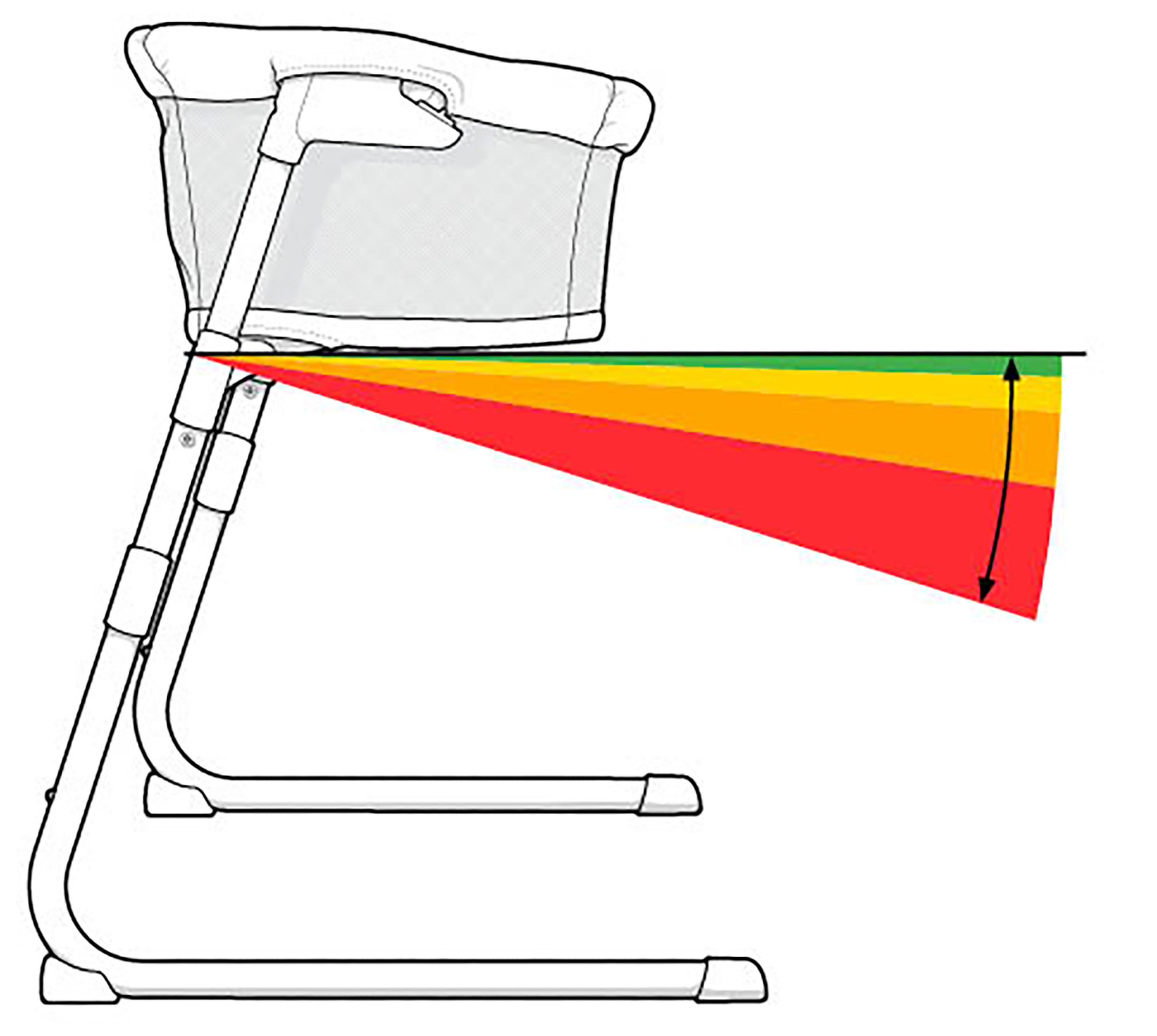
Roll over symbols for additional information. Tap symbols for additional information.
-
0 to .99 degree tilt
This is the amount of tilt CR’s safety experts consider safe, because an infant should sleep on a flat, stable surface. None of the bassinets in our testing had both lateral angles below 1 degree.
-
1 to 2.99 degree tilt
Three of the cantilevered bassinets in our tests exhibited tilt within this range on the lateral freestanding side.
-
3 to 6.99 degree tilt
Five of the cantilevered bassinets in our tests exhibited tilt within this range on the lateral freestanding side.
-
Greater than 7 degree tilt
None of the bassinets in our tests exhibited tilt within this range on the lateral freestanding side, but one tilted in excess of 7 degrees on the side closest to the base.
“CR’s recent testing showed that some cantilever-style bassinets tilted less than others,” Shin says. “But CR continues to have questions about this type of bassinet and whether it is the safest option for your child.”
Brown is also skeptical of the cantilevered design itself. “I have no clue why this structural design has any benefit,” she says. “The risk is just not worth it when there are other safely designed bassinet options out there.”
So If a Cantilevered Bassinet Meets a Standard, Is It Safe?
Muratore points out that standards establish minimum requirements; they don’t necessarily build in additional margins of safety. Passing a required test doesn’t mean a product has no potential weaknesses compared with another product. That’s especially important when a product’s design differs from the types of designs the standard was developed around.
“One reason we investigated these products is that current standards were largely developed around more traditional bassinet designs, while cantilevered bassinets have a different structure,” Kapoor says. “Our testing focused on whether the sleep-surface angle changes as weight is applied in different locations.”
Singhose says the problem is that everyday use can introduce variables that parents wouldn’t necessarily think to test. “The casual user would have no way to determine which factors were coming into play,” he says.
According to Dwyer, “certified cantilevered bassinets undergo independent testing designed to assess stability under real-world loads and supports the updated ASTM F2194-25 standard, including its lateral-tilt requirements.”
CR’s testing, however, found variability in the angles, and our experts say that a flat surface is the safest option for babies.
Companies Respond
CR contacted the manufacturers of the bassinets included in this investigation and asked them to respond to our test findings, explain how they test their products for safety, and address consumer safety incident reports, if any. We heard back from five manufacturers, all of whom said their products were fully tested for compliance with the existing standard and passed, which CR doesn’t dispute.
Angelbliss: The Angelbliss Electric Bassinet Bedside Sleeper showed an average lateral tilt of 4.63 degrees on the unsupported side, among the largest in CR’s tests. Angelbliss provided a detailed response to CR’s questions and shared the results of its internal testing, which showed lateral inclines that varied depending on where weight was placed in the bassinet, similar to what CR observed in our tests. When the test weight was placed in the center of the bassinet or on the supported side, the lateral inclination angle was less than when weight was placed closer to the unsupported side. A spokesperson for Angelbliss said in a statement: “Angelbliss takes infant safety and buyer feedback seriously. Our internal engineering review found that the sleep surface’s lateral response varies depending on load position. We have identified three buyer feedback cases concerning perceived tilt that was greater than expected, and this feedback prompted an engineering review and structural optimization.” The company told CR that these optimizations affect all Angelbliss models manufactured on or after July 27, 2026. The model CR tested for this evaluation was manufactured in January 2026. Angelbliss told CR: “Preliminary internal QA checks show reduced lateral angles in the optimized configuration. These internal checks are not offered as a substitute for testing under the prescribed ASTM method, and we will continue to review verified test data, buyer feedback, and product performance.”
Baby Delight: CR tested two versions of the Baby Delight Beside Me Dreamer Bassinet & Bedside Sleeper and observed tilting on the lateral freestanding side of 3.15 (for the Beside Me Dreamer Bassinet & Bedside Sleeper) and 4.58 degrees (for the Beside Me Dreamer Organic Bassinet & Bedside Sleeper). Baby Delight responded to CR’s questions and provided additional information about its own test results. A company spokesperson told CR: “Testing has been done both internally and by third-party laboratories … The maximum side-to-side tilt angle we’ve seen is just over 3 degrees, and the maximum head-to-toe tilt angle has never been over 1 degree; which are well within the ASTM F2194 requirements of ≤7 degrees lateral and 10 degrees head-to-toe.”
Cowiewie: In CR’s tests of the Cowiewie 5-Position Adjustable Bassinet, the average lateral inclination of the freestanding side was 2.2 degrees, which is less than five of the eight cantilevered models we tested. A spokesperson for Cowiewie told CR that “infant safety is Cowiewie’s highest priority,” and confirmed that its bassinet was tested by an independent, accredited third-party laboratory, as required by law. The company also shared its own independent lab testing results: “All measured angles captured by both Consumer Reports and our third‐party laboratory remain within the allowable limits of ASTM F2194‐25. Observable tilt in itself does not constitute a safety hazard. Compliance is assessed against the angle limits defined within the ASTM standard.”
Halo: The Halo BassiNest Swivel Sleeper Luxe had the smallest lateral tilt angle of any bassinet we tested, with a lateral ange of 1.02 degrees on the unsupported side and 0.25 on the side closest to the base. A spokesperson for Halo told CR: “We regularly test our products at CPSC accredited third-party labs to ensure compliance with the CPSC and ASTM guidelines, including ASTM F2194-25, which allows for 7 degrees of lateral slope. That said, we design our products to meet higher safety standards than those created by industry experts and adopted by the CPSC. The slope data furnished by Consumer Reports appears to corroborate that approach.” CR’s observed tilt angle for the Halo BassiNest Swivel Sleeper Luxe is much less than the tilt our previous testing measured for the BassiNest Portable Bassinet.
Halo said: “We stand behind the safety of BassiNest products when used in accordance with instructions and warnings. The safety of the families who use our products is very important to us, and we take any questions or concerns regarding product safety seriously.”
Kids2: The Ingenuity Dream & Grow Bedside Bassinet demonstrated an average lateral tilt of 3.52 degrees on the side farthest from the base support and 7.11 degrees on the opposite side. Kids2 disputed CR’s findings, saying: “Kids2’s top priority is the safety and well-being of the families who use our products. The Ingenuity Dream & Grow Bedside Bassinet has been independently tested by Intertek, a CPSC-accredited laboratory, and meets all mandatory safety and performance requirements, including the mandatory standard for side-to-side tilt. We stand behind the safety and compliance of our bassinet and remain committed to meeting, and where possible exceeding, the rigorous safety standards designed to protect infants and their caregivers.”
What to Do If You Already Have a Cantilevered Bassinet
Here are steps you can take to make sure your baby is sleeping in a safe space:
Check for recalls and incidents at SaferProducts.gov. You can check to see whether a product has been recalled on the CPSC website or at Recalls.gov, and also check for any safety incidents at SaferProducts.gov.
Follow assembly and setup directions to the letter. It’s important to make sure you’re using your bassinet exactly as directed by the manufacturer for safety. “[M]ake sure the bassinet is properly assembled, placed on a level surface, and used according to the manufacturer’s instructions,” says Michael Dwyer, president of the Baby Safety Alliance.
Stop using the bassinet immediately if you notice instability, wobbling, or tilting. “Parents should discontinue use if it becomes damaged or exhibits unusual movement or instability,” Dwyer says.
What to Look for When Choosing a Bassinet
Look for lots of mesh. CR’s Muratore recommends choosing a bassinet with plenty of breathable mesh. “The more mesh, the better,” she says. Avoid models with sidewalls composed of a lot of solid fabric. And when the bassinet is in use, keep the mesh sides well clear of your own bed, mattress, and bedding.
Check the mattress fit. The bassinet mattress should fit snugly against the side walls, without gaps. Only use the mattress pad provided with your baby’s bassinet so that it fits properly with no gaps.
Press on the sleep surface. It should feel firm or even hard. “‘Cushy’ is not a good thing in this situation!” Muratore says.
Pay attention to the base. A sturdy, level base is preferable. If you can see a bassinet in person before buying it, Muratore suggests pushing down on the sidewalls and gently nudging the stand to see how sturdy it feels.
Consider where and how you’ll use it. A height-adjustable model may make nighttime access easier if the bassinet sits beside your bed. Wheels can be useful if you plan to move it around the house.
Follow safe sleep basics. Babies should always be placed on their backs to sleep on a firm, flat, noninclined surface with only a fitted sheet. Keep blankets, pillows, toys, bumpers, loungers, and other soft items out of the bassinet. Don’t use weighted sleep sacks, weighted blankets, or any weighted wearable clothing on your baby.
Transition your baby out of the bassinet as soon as they outgrow it. Babies should be moved out of their bassinet and into a crib by the time they’ve reached the product’s weight limit, which is typically 20 pounds, or once they’re rolling over or showing signs of pushing up on their hands and knees, which tends to be between 3 and 6 months of age. They should then use a larger sleeping space with a firm, flat mattress, like a crib or play yard.
All of these steps can help you choose a bassinet with safety in mind. But as CR’s Kapoor puts it, product safety isn’t static.
“As a safety researcher,” she says, “I think it’s valuable to continue examining new designs to make sure existing tests remain effective and identify any gaps that may need to be addressed.”
For parents, the simplest takeaway is this: A safety standard is an important starting point. But when you’re choosing a place where your newborn will spend hours asleep, flat is still the gold standard.
Editor’s Note: This article, originally published Sept. 28, 2026, was updated on Sept. 30, 2026, to provide additional information about the head-to-toe tilt angle test results for the bassinets tested.


