




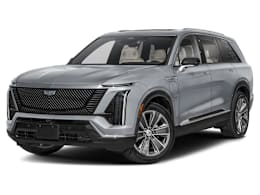
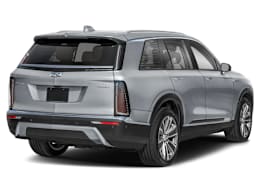
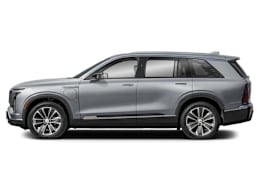
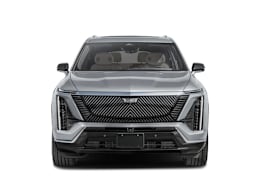
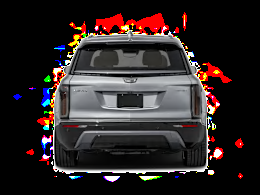
Cadillac is continuing to charge forward with its electric vehicle revolution, as it now has several SUVs to complement its traditional gasoline-powered lineup. We’ve already tested the low-slung Lyriq, evaluated the full-sized Escalade IQ, and we’re also testing the two-row Optiq. But this road test is all about the three-row Vistiq.
Like those other EVs, the Vistiq is based on GM’s Ultium electric vehicle platform, sharing much in terms of hardware, performance, and even interior treatments, including the distinct wide-screen infotainment system. And it’s more than just the general look that unites them: The electric powertrain and suspension tuning have a very distinct level of refinement that elevates these Cadillac EV SUVs beyond their conventional siblings.
The Vistiq has a dual-motor, all-wheel-drive powertrain with 615 hp that enables rapid acceleration. It has about a 300-mile driving range and a 5,000-pound towing capacity. After the Vistiq spent months in the hands of our testers, we concluded that this is a refined, well-rounded luxury SUV. It’s very quick, quiet, and comfortable, with a smooth and linear power delivery, a decent driving range, an intuitive brake pedal feel, and a luxurious cabin. The availability of General Motors’ excellent Super Cruise hands-free active driving assistance system only further sweetens a compelling package.
However, the Vistiq’s otherwise premium presentation is undermined by confusing, capacitive-touch controls that can be distracting to use while driving. Making matters worse, the Vistiq—just like General Motors’ other EVs—lacks compatibility with Android Auto and Apple CarPlay. And although it’s a fairly large vehicle, the third-row seat is surprisingly underwhelming in terms of space and comfort, and it’s difficult to get into and out of.
Still, even with those faults, the Vistiq is one of the best-performing Cadillacs we’ve ever tested, and it’s a compelling expression of the brand’s DNA.
“I very much enjoyed driving the Vistiq,” said one of our testers. “It's fast, quiet, and comfortable. It isn't perfect, and some fit and finish aspects are questionable at the price point, but it's a solid all-arounder and definitely competitive within the three-row EV SUV category.”
“I agree that overall this is quite a nice vehicle. It feels luxurious, thanks to its ride quality, noise isolation, and features. It’s also decently efficient for its size, and has good driving range and charging specs. There are some details where it falls short, such as certain aspects of the controls and a few interior rattles,” said another tester.
“This is a luxurious, classy, and distinctive vehicle that’s enjoyable to drive, with limited flaws,” agreed another tester. “Potential reliability concerns aside, it’s a very appealing vehicle. If a truly useful third row is important, though, I’d steer shoppers elsewhere.”
We bought a 2026 Cadillac Vistiq Luxury AWD for $79,715—anonymously from an area dealer, as we do with every vehicle we test—for the purpose of this road test review. Our Vistiq was assembled in Spring Hill, Tennessee.
Driving experience
With 615 hp from dual electric motors (which gives it standard all-wheel drive), the Vistiq delivers smooth, bountiful acceleration at a mere prod of the accelerator pedal, which adds significantly to its luxurious aura. The throttle pedal is very well tuned, which makes it easy for the driver to motor around serenely without abrupt acceleration or deceleration moments. This includes the Vistiq’s “one-pedal driving” modes, which enables the driver to speed up and slow down by using just the throttle pedal, without the need to step on the actual brake pedal. The Vistiq also benefits from a paddle on the steering wheel that allows the driver to engage progressive regenerative braking anytime they’d like.
One slight criticism we have is that the driver can only access the Vistiq’s full thrust by first pressing the “Vmax” button (short for “Velocity Max”) on the steering wheel, as if it were the electric version of nitrous. We think the driver should be able to have full power anytime they floor the accelerator pedal, though at least Vmax will stay on for the rest of your drive. It defaults back to “off” each time the Cadillac is turned off. But, to be fair, the Vistiq is extremely quick even without Vmax engaged.
With Vmax mode activated, the Vistiq zipped from 0 to 60 mph in 4 seconds. That’s slightly quicker than most other three-row EV SUVs, and it’s especially impressive considering that the Vistiq tipped our scales at a hefty 6,253 pounds.
The Vistiq managed 292 miles during our 70-mph highway-range test, which falls just a few miles short of the 305 miles that the EPA rates it at. That’s also pretty good considering that it’s a large and not especially aerodynamic vehicle.
The Vistiq holds the road well for a three-ton-plus SUV. It’s a wide machine, which on its own tempers how hard drivers might be comfortable pushing it through corners. But when we explored its road-holding limits on our track, the Vistiq proved stable and capable. Yes, it’s heavy, but the hefty battery is mounted low, the suspension is appropriately taut, and the steering loads up naturally through corners, although it has a rather artificial feel.
The Vistiq feels more German than American in terms of its ride comfort. The adaptive suspension has an underlying firmness to it, rather than a plushness. But while it doesn’t soak up all road imperfections effectively, it does an excellent job keeping the body from swaying back and forth and jostling occupants around on uneven surfaces.
Braking performance was up to the task, with competitively short stops on both our dry and wet surfaces. We also appreciated that, as with other Ultium vehicles we’ve tested, the brake pedal has a firm feel, with a short travel and a linear action, making it easy to come to smooth stops exactly where you want, without any odd regenerative braking behavior. But, the pedal can feel a little inadequate when slowing down quickly from higher speeds, causing the driver to have to step down on it pretty hard.
As with most EVs, the Vistiq’s cabin is very quiet overall, creating an isolated experience that is disturbed only by an occasional interior rattle and the faux electric motor sounds that, unfortunately, can’t be completely turned off.
Cabin comfort
Getting into the Vistiq is a bit awkward, thanks to the elegant but odd exterior door handles that extend when you approach the vehicle with the key fob. Their ultra-slim design makes them more akin to shaking someone’s finger “hello,” rather than grabbing their full hand.
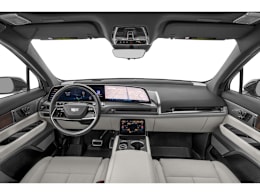
Once inside, the cabin makes a strong first impression. There is a nice variety of textures, with tasteful stitching and nickel-finish accents. It’s a chic interior that feels unique, sophisticated, and brand-appropriate. Some niggles include the underpadded headliner, ill-fitting material on the windshield pillars, and typically-flimsy GM steering wheel stalks.
The driver benefits from a pretty wide and open space, with lots of headroom and no concerns with the center console intruding on right knee space. The seating posture is chairlike, and the armrests are symmetrical. Unfortunately, several testers found that, no matter how they positioned the steering wheel, it ended up blocking information within the driver’s instrument screen.
Most of our team found the driver’s seat comfortable and supportive, although the seatback side bolsters were a touch restrictive for wider occupants. The door-mounted controls for the heated and ventilated seat functions can be difficult to discern when driving.
The second-row bench seat in our test vehicle (captain’s chairs are available) is quite spacious, with lots of headroom and good knee room. Even with the second row slid forward some to increase third-row legroom, there is enough space to accommodate adult passengers. It’s pretty comfortable, too, with soft padding and good underleg support. But the seat's flat shape makes it seem like you're sitting more “on” it than “in” it.
The third-row seat has decent headroom, but the posture is uncomfortable. The low seating position puts passengers’ knees way up in the air which results in zero underleg support, and foot space is squished underneath the second-row seats. Plus, for a reasonably large SUV, it’s a surprisingly tight squeeze to get into and out of the third row, especially on the driver’s side.
Controls and usability
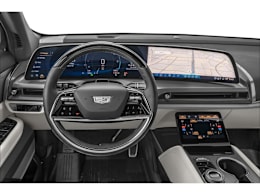
Almost all features inside the Vistiq are controlled by a combination of a 33-inch-wide dashboard screen and a lower touchscreen for climate controls. The massive yet crowded upper screen feels visually overwhelming because there is so much going on. Pale, thin lines constructing the text and icons contrast poorly with the blue background, making it difficult to differentiate the contents from each other. The lack of straightforward physical controls makes this system difficult to use.
Further, the secondary screen for the climate system forces the driver to divert their eyes low and away from the road to use it. Even the flush touchpads on the steering wheel are challenging to operate compared with separate, distinct buttons. Overall, the Vistiq’s infotainment system seems to prioritize aesthetics over ease of use.
Some of this wouldn’t be as much of a problem if the Vistiq was compatible with Android Auto and Apple CarPlay—but, as with all of GM’s EVs, it’s not. Almost every other brand—and even most other vehicles—allow users to pair their phones and integrate the navigation, streaming services, and calling features they are accustomed to these days.
Active safety and driver assistance
Standard active safety and driver assistance features include automatic emergency braking with pedestrian and cyclist detection, automatic emergency braking that operates at highway speeds, blind spot warning, rear cross traffic warning, reverse automatic emergency braking, lane centering assistance, lane departure warning, lane keeping assistance, adaptive cruise control, and automatic high beams.
Some of the Vistiq’s safety warnings are communicated via vibrations to the driver’s seat (called the “Safety Alert Seat”), a feature we’ve appreciated in numerous other GM products.
GM’s excellent Super Cruise active driving assistance system, which combines adaptive cruise control and lane centering assistance, comes standard on the Vistiq. The system allows for hands-free driving on pre-mapped highways and some two-lane roads, and we think it’s a good stress-reliever—particularly in congested traffic. It utilizes a direct driver monitoring system that makes sure the driver keeps their eyes on the road. The system is also capable of changing lanes on its own to get around slower vehicles when driving on the highway. A three-year OnStar subscription, which is required to use Super Cruise, is included with the vehicle purchase.
We’re happy to see that both a rear occupant alert system and a belt minder come standard. The former is designed to remind the driver—based on rear-door logic—to check the rear seat at the end of a trip to help prevent children and pets from suffering heatstroke or hypothermia if unintentionally left behind in the vehicle. The rear belt minder alerts the driver if a rear passenger unbuckles their seat belt during the trip. There’s also a standard Side Bicyclist Alert that will warn you to not open your door, when parked on the street, if the system detects a cyclist approaching from behind.