

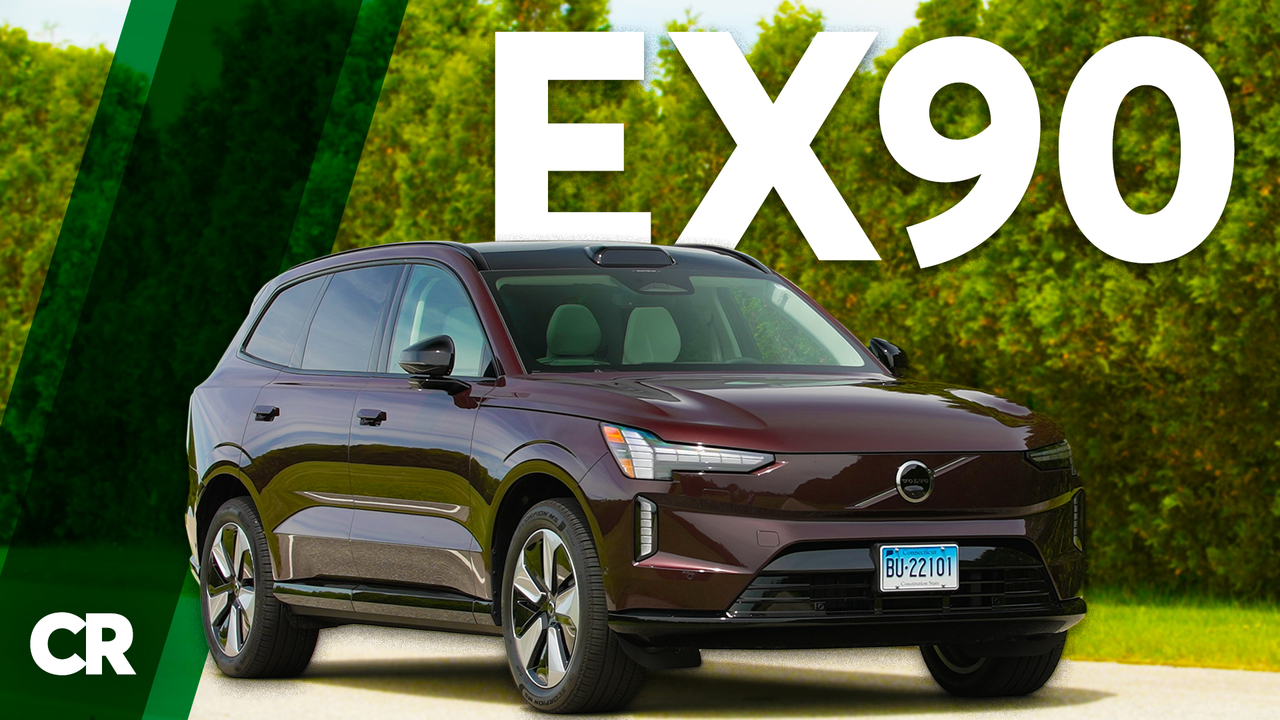


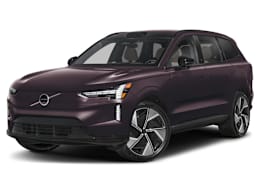
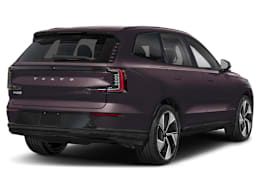
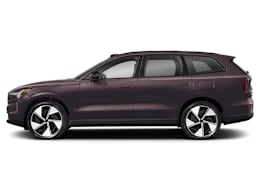
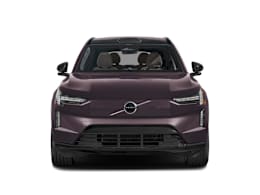
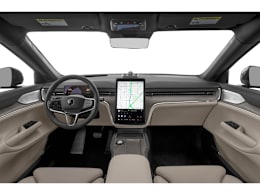
The Volvo EX90 is one of the more baffling vehicles we’ve tested. It’s a new all-electric three-row flagship SUV, designed from scratch by an automaker best known for safety advancements, staid designs, and incremental updates. It achieved a high road-test score thanks to its quick acceleration, hushed cabin, comfortable first- and second-row seats, and one of the nicest interiors we’ve seen in a while.
However, the EX90 we purchased for our test program has been a disappointment in numerous ways. For example, several of its advertised features, including its lidar sensor technology, weren’t functioning when it arrived at our track. Months later, some still have yet to be activated. The vehicle also needed numerous software updates and upgrades before we could test it, and required so many hard and soft resets that our technicians put together a cheat sheet, instructing drivers what to do if the radio failed, if the battery couldn’t be charged, if the screens went blank, or if any number of other common failures occurred. These issues would have been inexcusable on a new TV or phone, let alone a brand-new $81,000-plus luxury SUV from an established automaker.
The EX90’s early woes can largely be boiled down to the advanced engineering that underpins it. Like many new EVs, it is what automakers call a “software-defined vehicle.” While most cars rely on numerous small computers and systems that communicate with each other, software-defined vehicles like the EX90 are built around a single large computer that controls all functions, from the brakes to the radio. In theory, the design is supposed to minimize the amount of on-board electronics and allow automakers to fix faults, boost performance, and add features through over-the-air (OTA) updates. In practice, it’s a complex setup that Volvo hasn’t yet perfected.
Although we don’t factor the issues we encounter on our test vehicles into their reliability scores, our EX90 had significant enough problems that we can’t write about the car without mentioning them. In fact, the 2025 model’s faults are so widespread that Volvo is making major changes for 2026, including a new charging architecture and a new core computer. The automaker says it will also replace the core computer on 2025 models, essentially giving these early-build vehicles a brain transplant. However, the 2026 models will lack lidar, which was originally intended to be integrated into the EX90’s active safety and driver assistance features. Lidar is a unique sensor technology that uses lasers to precisely measure distances and is designed to help the EX90 detect pedestrians at night and prevent collisions with cars running stop signs. Lidar has yet to be activated on 2025 models, although the automaker says it will be, despite the fact that Volvo’s lidar supplier recently declared bankruptcy.
We plan to put the new core computer to the test as soon as it becomes available. However, even if Volvo fixes some of the EX90’s flaws, its complicated controls and other idiosyncrasies are so maddening that they negate many of the SUV’s strengths.
“When you're not fiddling with the controls, it actually drives quite well, with plenty of smooth, nearly-silent power, a quiet cabin, decent handling, a not-terrible ride, and a roomy, mostly well-sorted driving position,” said one of our testers.
“Overall, this is an unsuccessful implementation of modern tech,” said another tester. “The controls, phone integration, getting in and out, etc. This car was originally announced in 2022, but it’s now very late to the EV market. Its outdated electric architecture is evidence of that. This is not exactly a shining example of the modern software-defined vehicle.”
We bought a 2025 Volvo EX90 Twin Motor Plus AWD 7-Passenger for $81,290—anonymously from an area dealer, as we do with every vehicle we test—for the purpose of this road test review. Our EX90 was assembled in Ridgeville, South Carolina.
Driving experience
Like many EVs, the EX90 is quick and powerful. It’s not pin-you-into-the-seat kind of power, but with 402 hp from dual electric motors, there’s more than enough oomph for most situations—whether for confident city driving or when merging onto the highway. Not surprisingly, it scooted from 0 to 60 mph in a scant 5.4 seconds.
But that power isn’t always delivered as smoothly as other EVs, especially when the EX90 is in its default “Standard” drive mode, and it’s being driven with a bit of gusto.
“Press the throttle pedal pretty hard, and you get an initial acceleration response, followed momentarily later by a stronger burst of power,” said a tester. You can feel a disconnect between the front and rear axles as they engage or disengage, especially when taking off from a stop. We also noticed some torque steer when we pressed the accelerator pedal hard, which caused the steering wheel to move slightly back and forth in the driver’s hands.
While our testers appreciated that the EX90 has a true “coast” mode, which in theory should make it feel more similar to a conventional gas-powered car, the Volvo doesn’t feel like it slows down at all when you release pressure off the accelerator pedal—unlike regular vehicles. “This meant I was stepping on the brake pedal much more than I normally do,” a tester said.
On the other hand, most testers felt that the EX90’s “one-pedal driving” mode (which enables the driver to speed up and slow down by using just the throttle pedal, without the need to step on the actual brake pedal) worked reasonably well. The deceleration force is strong enough that you can come to a stop where you intend without having to use the brakes, but we found it took a bit more concentration to be smooth than with some EVs.
Driving range is paramount with EVs, and here the EX90 performed well. It managed a commendable 312 miles during our 70-mph highway-range test, exceeding the EPA’s estimate of 308 miles.
Steer the EX90 into a corner, and it feels fairly agile for its size, with quick turn-in, tight body control, and a balanced chassis that responds well to the driver’s inputs. The steering’s effort is a bit too light for our tastes, and it also lacks feedback to the driver. And while its quick reactions made it engaging on twisty roads and around our track, it can feel a bit twitchy in everyday use. As such, it requires extra concentration just to keep it tracking straight down the highway.
The suspension does a good job absorbing smaller bumps, and keeping the big SUV’s body level when driving on uneven pavement. However, it falls behind competitors when imperfections become larger; for example, potholes tend to punch through into the cabin in an almost brittle fashion.
Cabin noise, or really the lack thereof, is an EX90 strong suit. It does a great job isolating wind, road, and electric motor noise, which makes the interior feel serene.
Cabin comfort
Nearly every tester commented on the EX90's stylish interior. The white birch wood trim is unique without being gimmicky, and it adds to the cabin’s upscale ambience. Many surfaces are carpeted or trimmed in a leather substitute. Subtle chrome and a massive, fixed panoramic roof add brightness and a sense of airiness.
“I think the cabin is befitting of its $80,000 price tag, with nice contrasting colors and high-quality materials throughout,” said one tester. “Things feel well put-together,” said another.
We wish that the panoramic glass roof had a built-in shade that could completely block out the sun. Instead, owners must purchase an optional shade and attach it to the glass. The 2026 model gets an electrochromic roof that can be “dimmed” to block the sun.
The first two rows of seats are quite comfortable. They’re supportive and spacious, and a good fit for nearly all body types. But the third-row seat is among the tightest we’ve encountered—especially considering the EX90’s fairly large size. We expect third rows to be at least somewhat cramped, but the EX90 has so little headroom that anyone taller than 5-foot-8 or so will have to bend their head to even sit down. The seatback is also very upright and can’t be reclined.
The cargo area is neatly carpeted, but lacks a cover to conceal items from view. Although the third-row seats are power-folding, the second-row seats must be operated manually. We were able to fit two large suitcases behind the EX90’s third-row seat, which is decent. However, overall cargo room, with the second and third rows folded down, is a few cubic feet less than most of its competitors. There’s a small front trunk, or “frunk,” under the hood that can fit a backpack, along with a tiny storage area under the rear cargo floor. Unfortunately, the EX90 does not come with a spare tire.
Controls and usability
Our problems with the usability of the EX90 begin with simply trying to get into the vehicle. That’s because, unlike most vehicles, it doesn’t come with a traditional key fob. Instead, drivers are supposed to either connect the car to a phone app or use the supplied key card. There are indentations on the door handles that look like where you’re supposed to swipe the key card, but that’s not what they’re for. Volvo says pressing the indent will lock the car, depending on how your phone is set up.
Once you figure out where to tap the card on the driver’s door handle and get inside, you then have to place the key card or your phone on the wireless charging pad. Since the EX90 doesn’t have an ignition button, the only way to fully “wake up” the car is to press the brake pedal and shift the car into Drive or Reverse. That’s right: You can’t open the power windows without first shifting the SUV into gear. Luckily, when you release the brake pedal, the EX90 remains in a brake-hold mode until you press the accelerator pedal. However, we fear it would be all too easy for someone to turn the car on to open or close a window, forget they are in gear, and unintentionally accelerate. Additionally, a few of our testers found it challenging to determine when the car was fully “on.”
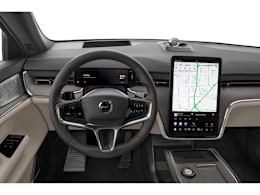
And now, a word on the EX90’s actual controls. Or really, many words. We don’t like them, due in part to a sheer lack of physical knobs and buttons. Instead, most interior functions are handled via the large, vertically oriented infotainment touchscreen or with capacitive-touch controls. The screen responds quickly to inputs, but it’s densely cluttered with icons and text. We like that there’s a separate display screen behind the steering wheel, with a speedometer and other gauges.
As with Tesla vehicles, commonly used functions such as those for the climate system, headlights, seat and mirror adjustments, and drive modes require the driver to use the touchscreen, which often involves navigating menus and multiple steps. While the split-screen interface is clean and allows for viewing multiple apps at once, splitting climate features across two separate menus and burying safety-related functions adds unnecessary complexity.
Other annoyances include the fact that there’s only one pair of power window switches on the driver’s door, along with a capacitive-touch button that toggles between the front and rear windows. The steering wheel controls aren’t illuminated at night. The glove box can only be opened via the touchscreen.
Because the system runs on Google software, you have to log in to the Google ecosystem to take advantage of most features. Logging a car into your Google account could cause privacy concerns, such as saving navigation destinations to your account history. Additionally, there isn’t an Android Auto option, although the system works with Apple CarPlay. Access to Google Maps and other Google features, such as the voice assistant, is included for four years; after this period, a paid subscription is required.
Active safety and driver assistance
Standard active safety and driver assistance features include automatic emergency braking with pedestrian and cyclist detection, automatic emergency braking that operates at highway speeds, blind spot warning, rear cross traffic warning, reverse automatic emergency braking, lane centering assistance, lane departure warning, lane keeping assistance, adaptive cruise control, and automatic high beams.
A rear occupant alert system comes standard, designed to remind the driver to check the rear seat when the EX90 is put into Park, helping to prevent children and pets from suffering heatstroke or hypothermia if unintentionally left behind in the vehicle. The EX90 also has a standard rear belt minder, which alerts the driver if a rear passenger unbuckles their seat belt during the trip.