
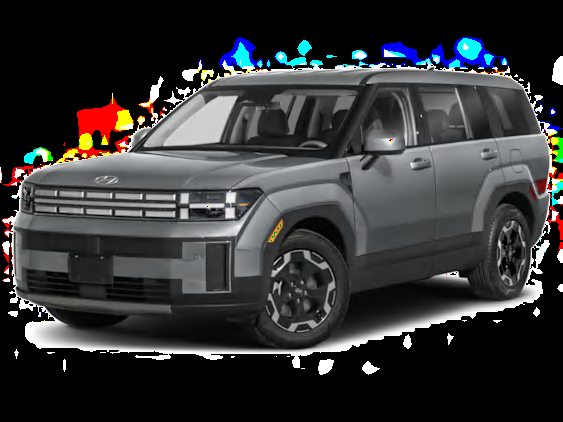
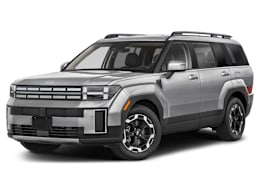
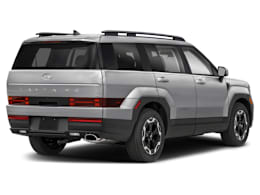
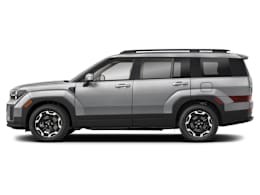
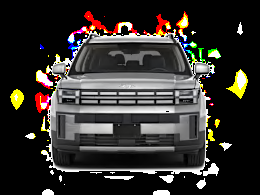
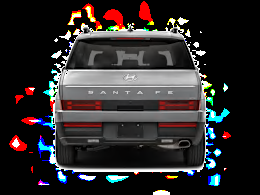
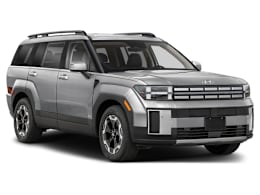
The Santa Fe falls somewhere between most compact and midsized SUVs. It’s small enough to maneuver in tighter confines, yet offers a standard third-row seat and plenty of cargo space. For 2026, Hyundai addressed one of our biggest complaints with the nonhybrid version by replacing its jerky dual-clutch transmission with a conventional eight-speed automatic. This move makes a huge difference in the SUV’s drivability, especially at lower speeds.
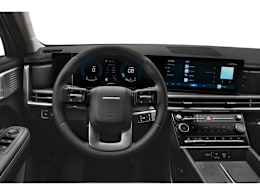
Otherwise, the Santa Fe retains its distinctively squared-off exterior styling, a striking cabin with its large, dual-screen display, good handling, a decent ride, comfortable seats, excellent outward visibility, and abundant small-item storage nooks. If you want something less bulky than a Hyundai Palisade but larger than a Tucson, the Santa Fe could be just the right size.
Hyundai Santa Fe at a Glance
- The conventional eight-speed automatic transmission introduced in 2026 is a dramatic improvement, with more predictable behavior at low speeds
- Comfortable ride provides a nice balance between good bump absorption and confident handling
- Quiet, spacious interior with a standard (albeit small) third-row seat
- Intuitive controls, aside from a low-positioned, capacitive-touch climate-control panel
- 23 mpg overall is a good reason to consider the 34-mpg Santa Fe Hybrid instead
We conduct more than 50 individual tests and evaluations on every vehicle we purchase at Consumer Reports’ 327-acre Auto Test Center in rural central Connecticut. Our testers also log thousands of miles on public roads over several months. After we tallied the results, the Santa Fe’s road-test score increased slightly, with the biggest improvement coming from the more refined powertrain.
“The best thing about this latest Santa Fe is that Hyundai dropped the dual-clutch transmission and is now using a real automatic,” said one of our testers. “The Santa Fe is like the poster child vehicle for why automakers should pretty much give up on DCTs and stick with conventional automatics. It makes a huge difference in the SUV’s daily livability.”
We purchased a 2026 Hyundai Santa Fe SEL 2.5T AWD for $41,510—anonymously from an area dealer, as we do with every vehicle we test—for the purpose of this road test review. Our Santa Fe was assembled in Montgomery, Alabama.
We also tested a Santa Fe Hybrid (covered in a separate road test), which notched an even more stellar road-test score. It’s much more fuel-efficient, although its acceleration isn’t quite as zippy.
Driving experience
The 277-hp, 2.5-liter turbocharged four-cylinder engine in the regular Santa Fe is now paired with a conventional eight-speed automatic transmission. The new automatic eliminates the low-speed delays and hiccups that plagued the previous dual-clutch setup. Now, takeoffs from stops are lurch-free and easy to modulate, upshifts are smooth, and downshifts come mostly when you expect them.
As one tester said, “The worst thing about the 2026 Santa Fe is the poor folks who bought the '24 and '25 versions with the dual-clutch transmission.”
However, the Santa Fe’s newfound powertrain refinement comes with a slight fuel-economy penalty, dropping from 24 mpg overall down to 23 mpg. It’s also not quite as quick as it was before; it still managed a commendable 7.5-second sprint from 0 to 60 mph, but with the dual-clutch, it did it in 6.7 seconds. Luckily, out on the road, the Santa Fe still feels plenty sprightly, and we think the trade-off for powertrain refinement is more than worth the slight drop in fuel economy and acceleration.
The hybrid version—which uses a smaller turbo-four with a six-speed automatic transmission—is even smoother, thanks to a shove of electric power off the line. But where the hybrid really outshines the regular model is in fuel economy; it managed an excellent 34 mpg overall in our testing.
In most other ways, the two Santa Fe versions mirror each other. That includes confident and capable handling and an absorbent ride. The Santa Fe feels more like the smaller Tucson when driving through curves than it does the larger Palisade. We appreciate its natural steering effort, though we wish it provided more feedback about road texture and tire grip when cornering. Body roll is restrained in common driving scenarios, though it becomes noticeable when charging hard into a turn. The suspension has a firm feel, but it’s absorbent, and keeps the SUV steady and controlled most of the time. It’s only on rougher roads that some hard hits come through into the cabin.
Panic-brake stopping distances proved impressively short. The brakes are easy to modulate, even though the pedal feels soft when initially pressed.
Despite its squarish body, the Santa Fe doesn’t suffer from excessive wind noise on the highway.
Cabin comfort
Most testers found the front seats reasonably comfortable and decent overall for the class. But opinions about the bottom cushion varied by body type: it was either too long, too stiff, or lacked enough side bolstering. The driving position is quite good in most ways, with tons of headroom and plenty of knee space. But many drivers found it difficult to position the steering wheel for both comfort and a clear line of sight to the instrument screen, finding themselves having to compromise one for the other.
The second-row seat is roomy and comfortable. There’s plenty of headroom, lots of foot space under the front seats, and really good underleg support. The tight third-row seat, although nice to have in a pinch, is best left to children. There’s a surprising amount of headroom, but the seat’s low position to the floor results in an uncomfortable knee bend, and the bottom cushion is flat and unsupportive.
The cargo area is generous, with a wide hatch opening and a low liftover height, which aids loading and unloading. Its 45.5 cubic feet of maximum cargo volume when the second- and third rows are folded down outpacks some larger SUVs.
Controls and usability
The Santa Fe’s dashboard features a curved screen integrating dual 12.3-inch displays for the digital driver's instrument screen and the infotainment system. Most controls are easy to use thanks to physical buttons and knobs for functions like temperature adjustment, audio volume, and tuning. But some icons are small, particularly the climate fan speed, making them difficult to adjust while driving. We do appreciate that you don’t need to wade into a specific climate menu to activate or adjust the heated front seats, as you do on some other new vehicles.
The unconventional, twist-action gear-selector stalk takes some getting used to, as we’ve experienced in other recent Hyundais. It’s on the right side of the steering wheel, near where the wiper stalk is often located. The driver makes a selection by rotating the tip toward Drive or Reverse. Depending on how you sit and whether the steering wheel is straight, it can be tricky to see the lever from behind the wheel. We found that you get used to it with practice, though.
Safety
Standard active safety and driver assistance features on the Santa Fe include automatic emergency braking with pedestrian and cyclist detection, along with automatic emergency braking that operates at highway speeds, blind spot warning, rear cross traffic warning, reverse automatic emergency braking, lane centering assistance, lane departure warning, lane keeping assistance, adaptive cruise control, and automatic high beams.
We’re happy to see that both a rear occupant alert system and a belt minder come standard. The former is designed to remind the driver—based on rear-door logic—to check the rear seat when the Santa Fe is turned off to help prevent children and pets from being unintentionally left behind in the vehicle. The belt minder alerts the driver if a rear passenger unbuckles their seat belt during the trip.
The Santa Fe also comes with a Safe Exit Assist system, which can sense if a vehicle or bicycle is approaching from behind or alongside when parked on a city street, and an occupant is about to open a door into traffic.