Your membership has expired

The payment for your account couldn't be processed or you've canceled your account with us.

Re-activate

Kia Telluride

EPA MPG: 20 mpg

Kia Telluride First Drive

Summary

Introduction

The 2027 Kia Telluride Has Cabin and Cargo Space, but We Aren't Sold on its Four-Cylinder Engine

Consumer Reports bought a new Telluride, the latest version of Kia’s three-row SUV that competes with the Ford Explorer, Honda Pilot, and Toyota Grand Highlander. Our experts found several welcome improvements, but we don’t love all the changes.


Overview

The Kia Telluride took the market by storm when it first went on sale for the 2020 model year. Before it arrived, the other established three-row SUVs each excelled in different facets of this family-focused category. Some had interior conveniences, others were fuel efficient, and others were reliable. Rather than find its own niche, the Telluride proved capable in just about every way that mattered to buyers. For several years, it was the most well-rounded midsized SUV. Now, the second-generation Telluride has a tough legacy to live up to, along with fresh competition.

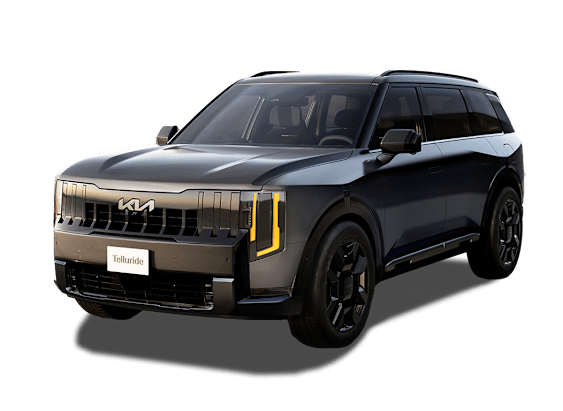
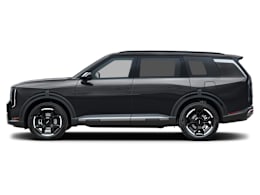
The most notable difference between the 2027 Telluride and the outgoing model is an increase in size. The new version grew 2.3 inches bumper to bumper, giving it a bit more space throughout the vehicle. The exterior looks more premium, too, and the interior gains big-screen pizzazz. For the first time, a hybrid powertrain is available.

The gas-only Telluride is available in LX, S, EX, X-Line EX, SX, X-Line SX, X-Pro SX, SX Prestige, X-Line, X-Line SX Prestige, and X-Pro SX Prestige trims. Pricing starts at $39,190 on the LX and ranges up to $56,790 MSRP. That is about a $3,000 increase over the 2025 Telluride ($36,390 to $53,685).

The hybrid line is slightly simpler: EX, SX, X-Line SX, SX Prestige, and X-Line SX Prestige. Prices span from $46,490 to $57,590. For all versions, the destination charge adds $1,545.

There are so many trims, with oh-so-many Xs, that it can be confusing. Think of the X-Line as the sporty-looking versions with much blackout trim. The X-Pro versions are the more off-road-capable editions, with all-terrain tires, upgraded suspensions, and increased ground clearance.

For our tests, we bought an EX. This is the third trim up in the line, and it packs what most buyers will consider essential features, plus a few niceties like synthetic leather upholstery, an upgraded driver’s seat, heated and ventilated front seats, and a heated steering wheel.

As before, the Telluride is manufactured in the U.S., while Hyundai imports its Palisade sibling from South Korea. That distinction means that Telluride buyers who finance will be eligible to deduct up to $10,000 in loan interest due to new regulations. This deduction is considered to be “above the line,” meaning it’s used in addition to the standard deduction. Bear in mind that this tax deduction will be phased out after 2028, possibly before the loan is paid off.

With all the changes, does the new Telluride live up to the original?

Read on to find out.

We bought a 2027 Kia Telluride EX AWD with 274-hp, 2.5-liter turbocharged 4-cylinder; 8-speed automatic transmission; and all-wheel drive. With several options, the total MSRP came to $48,080.

The final assembly point is West Point, Ga.

It competes with the Buick Enclave, Chevrolet Traverse, Ford Explorer, GMC Acadia, Honda Pilot, Hyundai Palisade, Mazda CX-90, Subaru Ascent, and Toyota Grand Highlander.

Impressions

What We Like

Front and rear access

Entering the Telluride is easy for passengers of various sizes, thanks to the combination of hip-height seats, low floor, tall ceiling, and large doors. Wide-opening doors make second-row entry simple, too, although most passengers will need to duck slightly to enter.

Ride

The suspension is a bit softer than with the previous Telluride, but not as cushy as the Palisade. Still, our test drivers praised its body control and passenger comfort, though our experiences varied depending on the roads we drove on. Overall, compared with its predecessor, the ride seems improved and should satisfy most buyers.

Cabin space

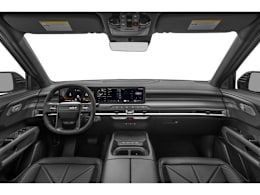
The interior storage is well-designed for the most part. Drivers appreciate the dual wireless phone chargers, the open space under the center console, and the helpful nook adjacent to the cup holders. However, the door pockets are oddly small for an SUV of this size.

Grab handles

Prominent grab handles flank the front center console. They look stylish, like a design flourish. They are also practical, allowing the driver or front passenger to adjust themselves using the stable grips as a handhold. They are not required to enter the vehicle, but they’re a nice feature.

Cargo space

There is decent space behind the third-row seat, even when it is in use, and there is some underfloor storage. The second- and third-row seats fold quite flat, drawing some minivan comparisons from our test drivers. On our EX, the second row has a powered tilt function, while the third row lowers with a simple tug strap. As one tester wrote, “It is perfect for hauling lots of stuff. This may be its greatest virtue.”

Some intuitive controls

The steering wheel controls are clear and easy to use. Thankfully, the infotainment system has physical climate buttons. However, we are not fans of the Telluride’s roller-style volume control. In most cases, a knob is better for making precise adjustments while driving.

Infotainment

The infotainment system is full of features but remains straightforward to use. We found it simple to pair phones, though, on subsequent trips, there is a delay between turning the Telluride on and having your phone re-paired and usable. We appreciate that there is a strip of controls below the touchscreen for common functions, including Home, Map, Search, Media, and Setup.

Second row

The Telluride has a minivan-like second row, with generous space and ceiling-mounted vents and climate controls. There is plenty of headroom, ample foot space under the second-row seats, and decent knee room. The bottom cushion is raised enough for good underleg support, but it is a bit long, favoring long-legged riders. The seat cushions are firm and flat, likely concessions that enable the seats to fold flat, though this compromises comfort on longer drives. Passengers appreciated the ample recline adjustability via the easy-to-use lever on the side of the bottom cushion, along with ample fore/aft adjustment. The door armrest is well-placed and reasonably padded. While the center drop-down armrest is well-placed, the passenger’s forearm rests on a narrow bit of padding and the plastic cup holder bits; the elbow, at least, is on a wider, well-padded portion. Retractable window shades at this modest trim level are a nice touch.

Visibility

Outward visibility is quite good from many angles, with a few limitations. There is a good view of the tall hood, helping the driver to place the vehicle accurately when parking. The front and rear side windows are huge, being both tall and long. The rectangular rear side glass is easy to see out of. However, the windshield pillars are thick and can obstruct diagonal forward views, especially when turning. The large front seat headrests and thick B-pillars (where the passenger doors are hinged) hamper over-the-shoulder views when passing. The rearmost pillar is wide, giving the Telluride driver less visibility toward the corners than with some other SUVs.

What We Don't Like

Powertrain

When the first Telluride arrived in 2019, other three-row SUVs were already adopting turbocharged four-cylinder engines. Even if their performance numbers matched those of the larger engines they replaced, these smaller-displacement versions tended to be noisy and sound strained. By comparison, the previous Telluride’s 3.8-liter V6 was smooth and delightfully simple. The new Telluride, however, has a 2.5-liter turbocharged four-cylinder that suffers the same shortcomings.

Noise is the chief concern. The Telluride’s turbo-four sounds stressed and gravely, and the eight-speed automatic transmission is busy. This is not the quiet, relaxed experience the last-generation V6 provided. Because the cabin is otherwise fairly quiet, with muted road and wind noise that only becomes prominent at elevated highway speeds, the engine sound does not align with the uplevel experience Kia seemed to be aiming for.

However, if you take the sound out of the equation, the powertrain has far more virtues than faults. The engine stop/start system typically refires quickly. The transmission is responsive when you nudge the gas pedal. The engine has good torque, and the transmission doesn’t always need to downshift to satisfy the driver’s demands. When downshifts do happen, they are fairly smooth.

Merging and passing power is quite good. Floor it, and the engine delivers a strong forward surge, making for confident passing maneuvers. Some drivers noted hesitation during a rolling stop, like in traffic, where the powertrain seems unsure if the driver wishes to slow further or get going. On balance, the new powertrain has its virtues, but we miss the old V6.

Ignition button

This control is on the gear selector stalk, behind and to the right of the steering wheel. As with the Hyundai Palisade and other Kia vehicles, our drivers are getting accustomed to this odd position. But it is often hard to spot, and there is no clear user benefit to the obscured location.

Third-row seat comfort

Adding to the length and wheelbase is a direct means for increasing interior space, and it is no surprise that the third row has good room for the class. Headroom is adequate for adults, and knee room is manageable, although foot space is squished. But space alone doesn’t equate to comfort. Factor in a low bottom cushion that leads to a significant knee bend and hard, unpadded plastic armrests, and the rear-most seat is best-suited to smaller riders on short trips.

Climate screen and controls

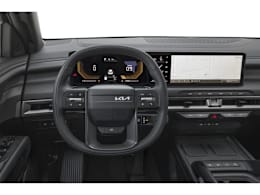
A common frustration among our test drivers is that the odd-shaped square-circle steering wheel partially or fully obscures the climate screen. Fortunately, the heated steering wheel and heated/ventilated seat controls are physical buttons on the door, like in some luxury vehicles. It seems odd at first, but once you know where to look, they are easy to see and reach.

What We'll Keep an Eye On

Front seat comfort

The initial impressions from the first six test drivers are mixed. The seats have a soft bottom cushion, but the seatback was a bit too firm for some drivers. We also received mixed feedback on the torso bolsters, which hug a bit more than those in some other midsized SUVs. The lumbar adjustment was key for some drivers to dial in comfort. The thigh extension is a nice touch for long-legged drivers. The headrest is too far forward for some, and unfortunately, it isn’t adjustable.

Fit and finish

The cabin is understated. If you look closely, you’ll see a nice variety of textures, with soft surfaces all around, including the doors and dash. Some drivers took issue with hard plastics, visible mold lines on the door pockets, and inconsistent panel gaps. While this is one of the better-looking black interiors, it does not feel like an upgrade over the previous Telluride.

Driving position

The driver is treated to roomy accommodations and an upright seating position with good outward visibility. There is generous head- and legroom. A downside of the large space is that some drivers found the armrests were far apart. More significantly, a common complaint was that the steering wheel obstructed key information on the instrument panel. That screen extends further to the right than to the left, making the driver feel off-center. The left footrest is glorious: Large, wide, comfortably angled. It is the ottoman of dead pedals.

Handling

The Telluride feels large, an impression magnified by dull steering and body roll when pushed. Although we have been railing against square-circle (“squircle”) steering wheels, this design is less awkward than some, and we didn’t mind it here as much as we do in other vehicles, like the Jeep Cherokee. Handling feels secure, but it won’t inspire enthusiastic driving—and that is just fine for a family hauler.

Fuel economy

This four-cylinder Telluride is EPA-rated at 20 mpg combined, the same as the prior V6. Given the persistent noise it generates, we’re not seeing any upside for owners from the powertrain swap. Our city and highway fuel economy tests will either dispel or reinforce our criticisms.

Styling

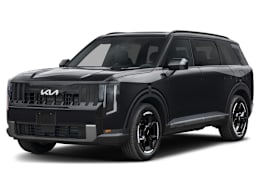
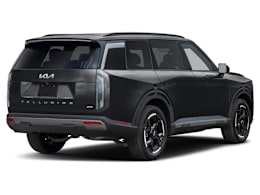
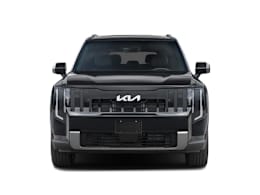
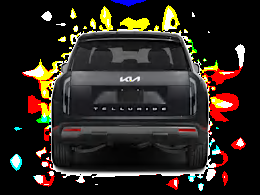
Consumer Reports doesn’t factor in styling when we assess vehicles, but we certainly spend a fair amount of time looking at and forming opinions about our test cars. To our eyes, the prior Telluride embodied all the essential traits for a midsized SUV, being upright and boxy, yet with elegant touches and a silhouette that reminded us of the Land Rover Range Rover. The new Telluride makes a stronger statement. There is a tasteful symmetry to the window lines that is often missing in SUVs. The smooth body, with its retractable door handles, looks like it would slip through the air. The shapes are so simple that the Telluride looks like a CGI illustration that popped off a computer screen. But then there is the grille. It looks like the unfinished space one might imagine behind a traditional grille.

Some of us have also disparaged the little nonfunctional tabs on plastic wheel arches. And there are two convex shapes on the lower sill trim that look like handles, suggesting they could pull out to be steps for accessing the roof rack. But no. They serve zero purpose. We know that sometimes a car’s looks can grow on you. At this stage, however, the staff is still divided over the appearance.

Exterior door handles

Retracting door handles enhance the exterior’s sleek elegance. Unlike such features on other models, the Telluride’s handles present in a timely manner and feel good to grip. They add a premium touch, but some drivers still have a natural apprehension for overcomplicating such a basic function.

Safety and Driver Assistance

The Telluride includes the brand’s latest bundle of active safety and driver assistance systems, including automatic emergency braking, blind spot warning, and rear cross traffic warning. Other available features include adaptive cruise control, lane centering assistance, driver attention monitoring, and safe exit, which prevents passengers from opening a door in the path of oncoming traffic when parked.

The Telluride comes with a rear occupant alert system that uses radar to detect children left in the rear seat when the vehicle is parked and locked. If it detects movement, the SUV will honk the horn and send an alert to the driver’s phone. Such a system provides valuable protection, reducing the risk of a child being left behind unknowingly. 

A video rearview mirror is available that uses a liftgate-mounted camera to give an unobstructed view behind the SUV. We’ve found that this feature is most appreciated when the vehicle is loaded with passengers and cargo.

Change Vehicle