
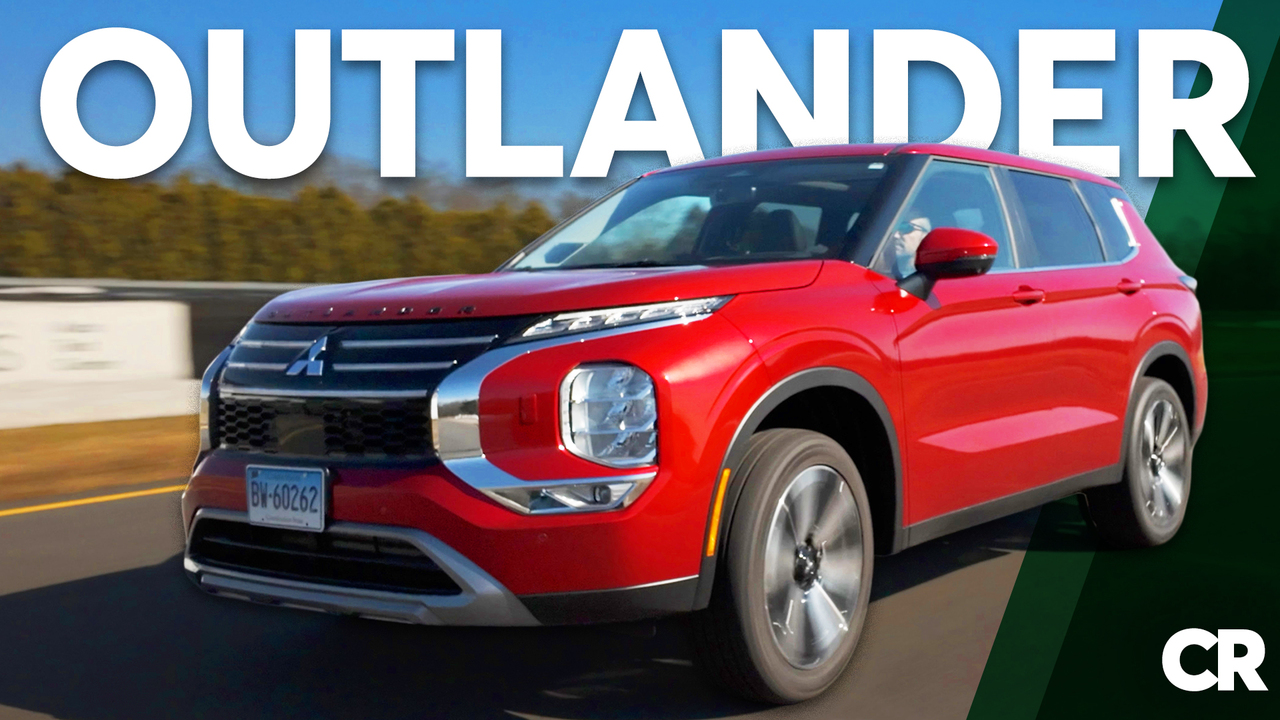
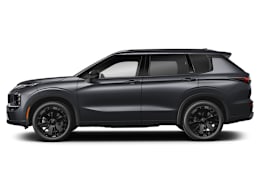
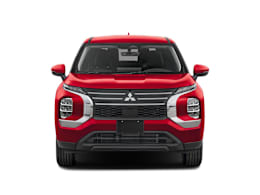
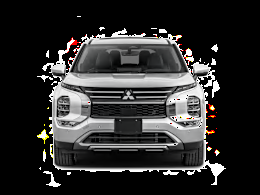
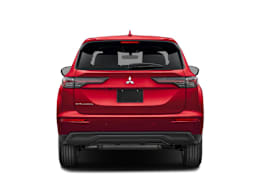
The Mitsubishi Outlander received a modest freshening for 2026, with the biggest change being the switch to a turbocharged mild-hybrid powertrain. Although our testers found the Outlander to be slightly improved, it still trails other small SUV entries in ride quality and overall refinement, including the Nissan Rogue, the SUV that the Outlander is based on. And while the Outlander’s third-row seat distinguishes it from most of its competition, the reality is that it’s tiny and of limited use.
Under the hood is a new 174-hp, 1.5-liter turbocharged four-cylinder mild-hybrid mated to a continuously variable transmission (CVT). While it provides a small improvement in fuel economy—2 more mpg overall in Consumer Reports’ tests than the previous Outlander with its 181-hp, 2.5-liter four-cylinder—the powertrain has enough other trade-offs (occasionally lurchy throttle delivery, a lack of power at higher speeds, and unpleasant sounds at higher revs) that it doesn’t feel like that much of a win.
Mitsubishi Outlander at a Glance
- Mild-hybrid powertrain introduced for 2026 improves fuel economy, but lacks power and refinement
- Driving experience suffers from poor bump absorption, limited steering feedback, and noticeable body roll
- Simple and intuitive physical buttons, knobs, and switches for most frequently accessed features
- Comfortable and supportive front seats
- Standard third-row seat sets it apart from other compact SUVs, but it’s only suitable for small children
A plug-in hybrid version was introduced in 2023. It was also updated for 2026, including receiving a larger 22.7-kilowatt-hour battery. It has an EPA-rated electric range of 45 miles before transitioning to hybrid operation. It’s considerably quicker and quieter than the regular Outlander.
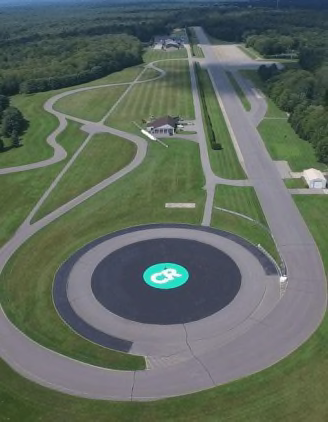
After our testers spent months compiling results from more than 50 specific tests and evaluations at Consumer Reports’ 327-acre Auto Test Center in central Connecticut, along with lots of miles behind the wheel on public roads, we found the Outlander to be unimpressive among its peers.
“This Meh-subishi feels like flashy mediocrity,” said one of our testers. “It presents well in the showroom, but just about every dynamic element trails the big brands. It’s a case where the Outlander is merely competent in a class filled with great vehicles. Why would you overlook Honda, Toyota, Hyundai, or Kia to end up here? A love of chrome exterior accents?”
Another tester gazed more positively at the Outlander. “It’s easy to just get in and go, thanks to the simple controls. It also has comfortable front seats, and the engine feels fine when you’re just cruising around town. The problem is that it’s underpowered when you really need to move. Similarly, while the car initially seems to ride okay, as soon as you encounter a rough road, it feels choppy and unrefined. There are too many better options out there in this tough segment.”
We bought a 2026 Mitsubishi Outlander SE 1.5T S-AWC for $42,680—anonymously from an area dealer, as we do with every vehicle we test—for the purpose of this road test review. Our Outlander was assembled in Okazaki, Japan.
Driving experience
Replacing the previous sluggish 2.5-liter four-cylinder engine is an also-sluggish turbocharged 1.5-liter four-cylinder with a 48-volt mild-hybrid setup, mated to a CVT. Acceleration is leisurely and pretty much identical to that of the 2025 model, with a 0-to-60-mph time of 9.8 seconds. While the powertrain works fine around town, it runs out of steam when you need a burst of acceleration at higher speeds, such as on the highway or to get around a slower vehicle in a two-lane passing zone.
Further, the small engine sounds overworked on the highway, and noticeable vibrations creep in through the steering wheel at higher revs. It’s also strange that, even though it’s a mild-hybrid, the gas engine rarely turns off while coasting. On the bright side, the CVT mimics a traditional automatic with simulated upshifts to help keep revs from skyrocketing out of control.
The Outlander is easy to drive around town, with light steering effort and a tight turning radius. Notable body roll and limited steering feedback detract from its handling when driven at a faster pace though. At higher speeds, the steering can feel a bit too quick, and when tracking straight on the highway, you’re left searching for a defined on-center position.
Ride quality is similarly unrefined, with poor bump absorption. The Outlander feels bouncy, floaty, and poorly tied down over rougher surfaces. One driver went as far as to say it “feels like an old body-on-frame SUV.”
As a result, even with decent front-end tire grip, a well-balanced chassis, and improved overall handling, the Outlander’s 53 mph still lags behind some similarly-sized SUVs in our avoidance maneuver test. Panic-braking performance proved good in both the dry and the wet, despite a slightly soft brake pedal feel.
Cabin comfort
We were pleasantly surprised by the fit and finish of the Outlander we tested. The cabin has ample padded surfaces, tastefully contrasting materials, and soft, suede-like center sections of the seats, all of which help justify the $42,000-plus we spent on it.
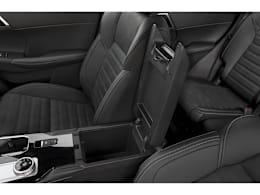
Most testers had positive comments about the comfortable and supportive front seats, which benefit from well-defined seatback side bolsters. The suede-like inserts provide a bit of extra grip through turns and are cooler on hot days than leather or faux leather. We also liked the feel of the perforated leather steering wheel, and the front armrests are nicely padded. Several testers found the left footrest to be too narrow, and those who prefer a lower steering wheel position noted that the rim blocked their view of some icons on the driver’s instrument screen.
The second row is comfortable, despite the bench’s flat shape, though some found the raised, stadium-style seating too high. Being able to move the seat fore/aft and recline the seatback are big pluses for passengers to find a comfortable position.
The third row is where the Outlander’s interior falls short; as in, whoever rides back there has to be pretty short to fit without hitting their head on the roof. A third row is rare in the compact SUV class, and it does give the ability to haul seven people in a pinch. But it’s so tiny and cramped that most adults simply won’t be able to fit back there. The seat does fit neatly into the floor if you’d rather use the space for cargo, but the cover that flattens the area behind the second row doesn’t latch down in place and can flop up and down when driving over harsher bumps.
Controls and usability
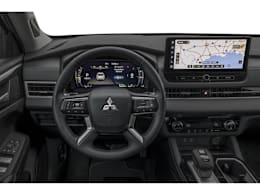
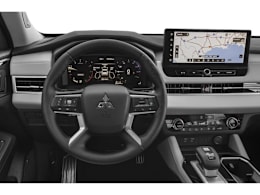
The Outlander’s interior is a breath of fresh air when it comes to usability, as it’s full of straightforward physical knobs, buttons, and switches. For example, the climate system functions are all physical controls, with nothing hidden in a specific, on-screen menu. All items are on a dedicated panel of buttons and knobs just above the center console.
The 12.3-inch central infotainment touchscreen, which was introduced in 2025, is less cluttered and more responsive than its predecessor. But the built-in navigation system looks and feels outdated, which made our testers all the more grateful that wireless Android Auto and Apple CarPlay are standard. An icon for these phone-mirroring functions appears in the left menu bar when your device is connected, making it easy to switch back and forth between phone apps and the Outlander’s default menus.
The digital driver’s instrument screen offers good contrast and is generally easy to read, but its complex settings menu can be difficult to navigate while driving.
Active safety and driver assistance
Standard active safety and driver assistance features on the Outlander include automatic emergency braking with pedestrian detection, automatic emergency braking that operates at highway speeds, blind spot warning, rear cross traffic warning, reverse automatic emergency braking, and automatic high beams.
Our vehicle was equipped with adaptive cruise control that works in stop-and-go traffic and lane centering assistance, which are bundled under the name “MI-PILOT Assist.” MI-PILOT and lane departure warning are standard on the third-tier SE all-wheel drive and above (though notably, not the front-wheel-drive SE).
The Outlander comes standard with a rear occupant alert system that is designed to remind the driver—based on rear-door logic—to check the rear seat when they turn the vehicle off, helping prevent children and pets from being unintentionally left behind. However, the driver must first enable this feature through the settings menu. There’s also a rear belt minder, which alerts the driver if a rear passenger unbuckles their seat belt during the trip.